
Dream career or calculated risk?
Freelancing in India once felt like rebellion.
Quit the office.
Work in pajamas.
Earn in dollars.
Reply to emails from a café instead of a cubicle.
It sounded like heaven and tasted like freedom.
But in 2026, freelancing in India isn’t a shiny side hustle anymore. It’s a serious career path; it is now competitive, fast-moving, and constantly evolving.
Freelancing in India is no longer easy money. The market is more competitive. AI tools are reshaping workflows. Clients are smarter. Platforms are saturated. And expectations are higher than ever.
So the real question is:
Is freelancing in India still worth it in 2026?
Let’s try to understand this change, practically, honestly, and strategically.
The Evolution of Freelancing in India
Freelancing in India didn’t grow overnight. It evolved in phases, bit by bit, until it became a fully grown career choice for many.
Phase 1: The Side Hustle Era (2012–2018)
Freelancers were mostly:
- Graphic designers
- Content writers
- Web developers
Clients came through:
- Fiverr gigs
- Facebook groups
- Word of mouth
It wasn’t structured, respected, or stable.
Most freelancers undercharged heavily — ₹300 blogs, ₹1,000 logo designs, ₹500 social media packages.
It was survival mode.
Phase 2: The Remote Boom (2020–2022)
The pandemic changed everything.
Suddenly:
- Global companies hired remotely.
- Zoom became normal.
- Dollar payments became accessible.
Indian freelancers discovered something powerful: Their skills were global.
A writer charging ₹1,500 per article locally could charge $150 internationally. It was a turning point in the field of freelancing in India. The earning gap widened.
Phase 3: The Professional Era (2023–2026)
Now, freelancing is not just “doing projects.”
It’s:
- Building a niche
- Creating authority
- Positioning as a consultant
- Charging retainers instead of one-time fees
The market matured. And when markets mature, they become harder, but more rewarding. Freelancing evolved from “doing tasks” to “selling expertise.” Hence, that shift is critical.
According to a recent Economic Survey, India’s gig workforce has jumped from around 7.7 million workers in FY21 to 12 million in FY25, and is projected to grow even more, potentially constituting 6.7% of India’s non-agricultural workforce by 2029-30.
That’s not a fad. That’s a structural shift.
Another study shows India hosts more than 15 million freelancers, making it the second largest freelance market in the world after the US.
Therefore, freelancing in India is no longer fringe; it’s mainstream.
Why Freelancing is Surging
Let’s break down the forces that pushed freelancing forward:
1. Digitization Across the Board
Smartphones, fast internet, digital payments — this isn’t niche anymore. It’s everyday reality.
2. Remote Work Culture
Post-pandemic, companies worldwide now hire remote talent constantly — and Indian professionals are prime candidates.
3. Global Clients, Local Talent
Indian freelancers often earn more working for US, UK, and European clients than many local jobs would ever pay.
4. Youth Willingness to Try New Work Models
Today’s young workforce prioritizes flexibility, skill growth, and diversified income, something research attributes to the broad adoption of freelance work. Freelancing in India isn’t just about surviving anymore; it’s about new foundations for work.
However, it has also made freelancing in India a competitive place to land a job.
Freelance Jobs in India
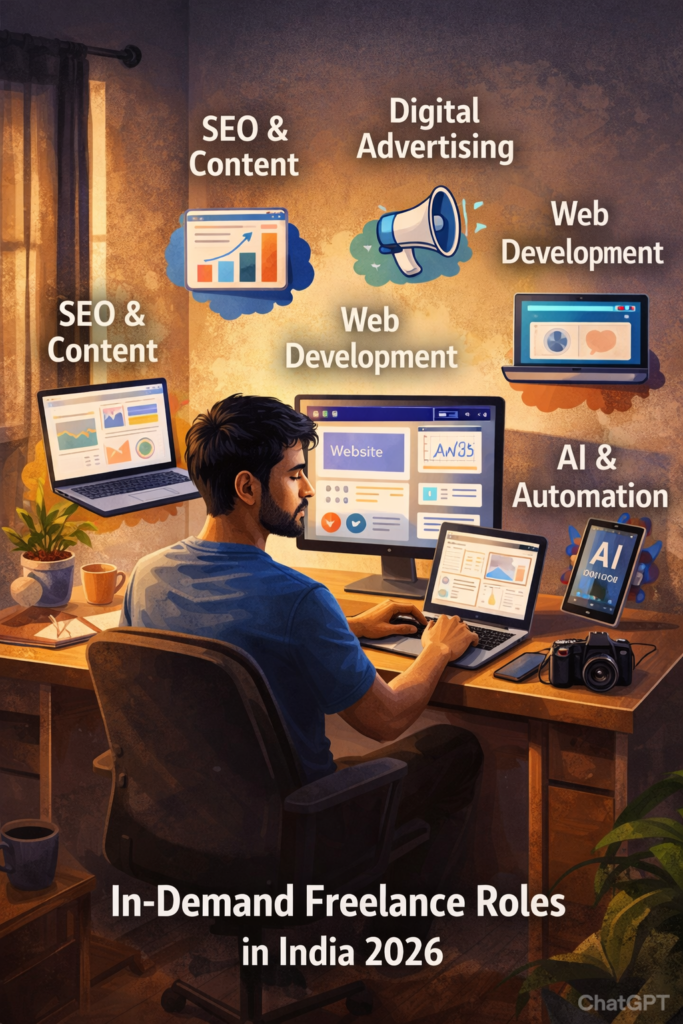
Let’s be clear: not every freelance skill earns equally.
Here’s where serious demand exists in India today:
1. SEO & Content Strategy
Businesses have understood something crucial: Traffic = leverage. But generic blogging doesn’t work anymore.
They want:
- Keyword clusters
- Topic authority
- Conversion-driven content
- AI-assisted but human-optimized writing
A skilled SEO strategist in India can charge:
₹50,000–₹2,00,000 per month on retainer.
If you want to write better and smarter, these are some of the best content writing courses to learn from.
2. Performance Marketing (Meta & Google Ads)
Every D2C brand in India is fighting for visibility. And ad costs are rising.
Which means brands want freelancers who:
- Understand ROAS
- Optimize funnels
- Track analytics
- Reduce cost per acquisition
Performance marketers who deliver results are rarely out of work.
3. Web Development & No-Code Specialists
Small businesses don’t want expensive agencies.
They want:
- Shopify store setup
- Landing page builds
- Webflow websites
- Funnel integrations
The no-code economy is growing fast in India.
4. Video Editors & Short-Form Strategists
Reels changed the game.
Creators, coaches, brands, everyone needs attention. A skilled video editor who understands retention patterns can charge premium retainers. This space isn’t slowing down anytime soon.
5. AI Automation & Workflow Experts
This is the 2026 goldmine.
Businesses want to automate:
- Email sequences
- CRM flows
- Content repurposing
- Lead nurturing
Freelancers who combine tech + business logic are in huge demand.
6. Niche Consultants
Here’s the real shift: Generalists struggle. Specialists thrive.
Instead of “I’m a content writer,” the winners say: “I help SaaS startups increase organic traffic through technical SEO content.”
Specificity builds income.
How Much Do Freelancers in India Earn
Let’s talk numbers realistically. Not Instagram highlight reels.
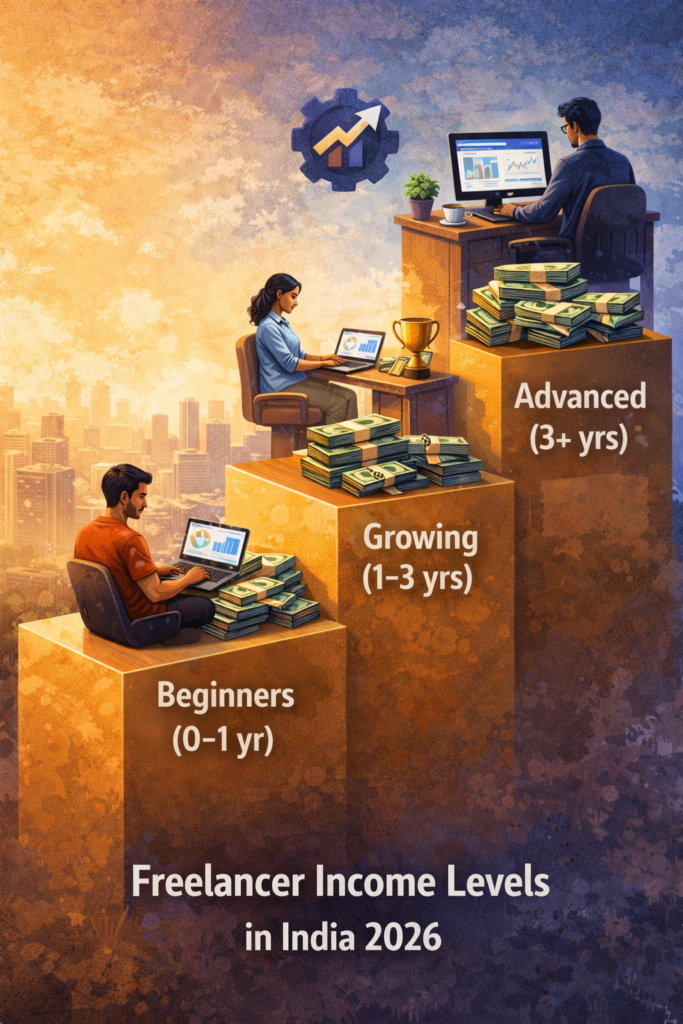
Beginner (0–12 months)
₹10,000 – ₹40,000/month
Usually juggling:
- 3–5 small clients
- Low rates
- Proposal rejections
This stage tests patience.
Growing Freelancer (1–3 years)
₹50,000 – ₹1.5 lakh/month
Has:
- Clearer niche
- Better portfolio
- Repeat clients
- Referrals
This is where momentum builds.
Advanced Freelancer (3+ years)
₹2 lakh – ₹5 lakh/month
Understands:
- Systems
- Positioning
- Client psychology
- Pricing strategy
At this level, freelancing becomes predictable.
However, reaching here requires deliberate growth, and the key difference isn’t just talent. It’s positioning + consistency + client strategy.
A Story: Two Freelancers, Two Paths
Let’s illustrate something important.
Case 1: Neha
Neha started freelancing as a “content writer.”
She:
- Charged ₹500 per blog
- Took any topic
- Relied only on freelancing platforms
By 2026:
- She works long hours
- Earns ₹35,000/month
- Feels stuck
She’s skilled.
But she never repositioned.
Case 2: Kabir
Kabir also started as a writer.
But he:
- Focused only on SaaS startups
- Built LinkedIn presence
- Created case studies
- Raised rates yearly
By 2026:
- He has 4 retainer clients
- Earns ₹2.8 lakh/month
- Works 5 focused hours daily
The difference wasn’t talent.
It was clarity.
Freelancing rewards positioning.
Best Freelancing Sites in India for Beginners
If you’re starting, platforms help you enter the market. Some of the best freelancing sites in India for beginners include:
- Upwork – Professional but competitive
- Fiverr – Easier entry via service packages
- Freelancer – Large job listings
- LinkedIn – Direct networking and outreach
- Internshala (Freelance section) – Beginner-friendly exposure
Over time, however, successful freelancers move beyond platforms and build direct client relationships.
That means, platforms introduce you. Personal branding sustains you.
The Pros and Cons of Freelancing in India

The Pros of Freelancing in India
Here’s why many jump into freelancing with enthusiasm:
1. Unlimited Income Potential
A job has a salary band. Freelancing has leverage.
You can:
- Raise rates yearly
- Move to retainers
- Add premium services
- Serve global clients
The ceiling is self-created.
2. Geographic Freedom
You don’t have to move to Bangalore or Mumbai.
You can work from:
- Tier-2 cities
- Your hometown
- Another country
This matters deeply in India, where relocation can be expensive and emotionally draining.
3. Global Access
One US client paying $1,000/month = ₹80,000+.
That’s life-changing for many people in India.
Remote work has normalized international collaboration.
4. Skill Expansion
Freelancers accidentally learn:
- Sales
- Negotiation
- Branding
- Finance
- Time management
These skills compound long-term.
The Cons of Freelancing in India
Now the uncomfortable part.
1. Income Instability
Clients leave. Projects end. Markets fluctuate.
There’s no HR department protecting you.
2. Competition & Pricing Wars
Platforms are heavily crowded. Many beginners undercharge to increase client numbers.
This creates downward pricing pressure.
3. Burnout Risk When you are:
- The marketer
- The executor
- The accountant
- The sales team
It can get overwhelming. Without systems, burnout is common.
4. AI Disruption
AI tools now:
- Write basic blogs
- Generate ad copies
- Create designs
- Suggest code
Freelancers who rely only on basic execution struggle.
Strategic thinking is now the real currency.
Freelancing in India vs Full-Time Job in 2026
| Factor | Freelancing | Job |
| Stability | Low–Medium | High |
| Income Ceiling | High | Limited |
| Flexibility | Very High | Medium |
| Risk | High | Low |
| Growth Speed | Fast | Structured |
Who Should Choose Freelancing?
Freelancing works best for:
- Self-driven individuals
- Long-term thinkers
- People comfortable with uncertainty
- Specialists
- Continuous learners
If you expect quick money — it disappoints.
If you build patiently — it pays.
Who Should NOT Choose Freelancing?
Let’s normalize this.
Freelancing is NOT for you if:
- You hate uncertainty
- You need stable monthly income
- You struggle with self-discipline
- You avoid selling yourself
Freelancing is 30% skill, 70% mindset.
Is Freelancing in India Legal?
Yes, freelancing in India is completely legal.
You function as a self-employed professional. Income must be declared properly, and GST registration may apply once you cross the prescribed threshold.
For official guidance, refer to the Income Tax Department of India.
Taking legality seriously turns freelancing in India from “side hustle” into “career.”
Is Freelancing in India Still Worth It?
Yes — but not casually.
The “easy freelancing money” era is over.
Now it requires:
- Niche clarity
- Skill depth
- Personal branding
- Continuous upskilling
- Smart client acquisition
If you treat freelancing like a business, it pays like a business.
If you treat it like a hobby, it pays like pocket money.
Final Verdict: Should You Start Freelancing in India?

Ask yourself three questions:
- Am I ready to learn sales, not just skills?
- Can I handle unstable income initially?
- Am I willing to specialize instead of generalize?
If the answer is yes — freelancing is absolutely worth it.
But success won’t come from copying YouTube tutorials.
It comes from:
- Strategy
- Consistency
- Positioning
- Patience
Freelancing in India isn’t dead.
It’s just more mature.
And in a mature market, amateurs struggle and professionals win.
Frequently Asked Questions (FAQs)
Yes, it is worth it for those who specialize, build authority, and treat freelancing as a business, not just a side gig.
Yes, freelancing in India can still be profitable in 2026, especially in digital and technical niches. However, profitability depends on skill level, specialization, and client positioning.
Competition is intense, but demand is growing, especially in digital fields like SEO, development, and marketing. Strategic positioning helps you get better work.
Freelancers earn in India between ₹8,000 to ₹1,00,000+ per month, depending on experience, niche, and client quality.
Yes, freelancing is legal in India. Freelancers must declare income properly and comply with tax regulations including GST if applicable.
For more information refer to the official site: Income Tax Department of India.
The best freelancing sites in India for beginners include Upwork, Fiverr, Freelancer, LinkedIn, and Internshala.